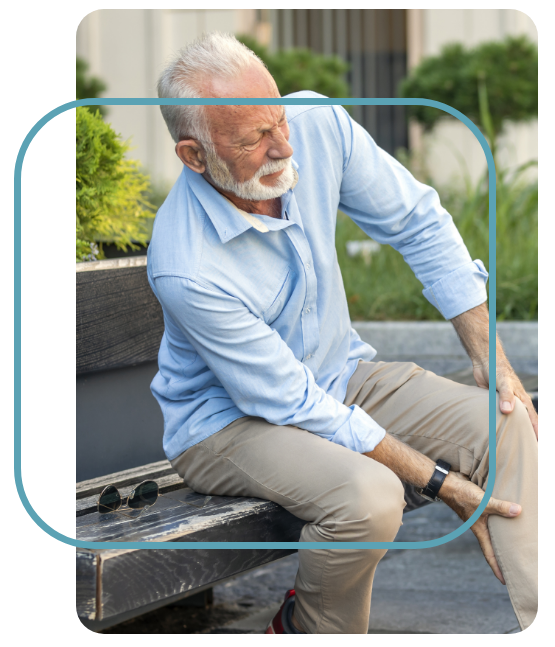
Knee replacement surgery, also known as knee arthroplasty, involves replacing a damaged knee joint with an artificial implant. It’s usually recommended to relieve the symptoms of arthritis but can also cure sports injuries and fractures.
We usually consider a knee replacement only when less invasive treatment options have been exhausted, for example, medication, physiotherapy and cortisone injections.
If conservative treatments fail to provide long-term relief from pain and immobility, a knee replacement can offer excellent results.
Your personalised knee replacement
Depending on which part of your joint is damaged, you might need a total knee replacement or a partial knee replacement.
We’ll scan your knee to create a 3D image of your joint, so Mr Shah can tailor your surgery to your exact needs and create a prosthesis that’s unique to you.
We always aim to retain as much of your knee joint as possible, while making sure you get the best result. Mr Shah uses a less invasive approach, which uses a smaller incision, resulting in less trauma to the surrounding tissues, a shorter recovery time and less discomfort post-op.
After being referred to Mr Shah, he agreed to replace both knees, three months apart. At the time it seemed a long recovery period, but now 18 months later my level of fitness has improved so much that I am taking part in a sponsored trek in Morocco next June.
Your knee replacement will be carried out under a general or spinal anaesthetic, so you won’t be aware of the procedure or feel any pain. You’ll be under the care of an experienced anaesthetist throughout your operation.
During your surgery, Mr Shah will carefully remove any damaged bone and tissues, before fitting your prosthesis. Mr Shah performs hundreds of knee replacements every year. It’s a straightforward operation that usually takes around an hour to complete.
Supporting you at every step
You’ll need to stay in hospital for a few days after your operation, but with the help of crutches, you’ll be back on your feet within 24 hours. Physiotherapy is an essential part of your treatment and will help you to build strength in your knee and learn how to use it in the correct way. With a little determination, you’ll be able to start gentle exercises within a few weeks, gradually building yourself up to more strenuous activities.
We’ll see you for your first follow-up appointment two weeks after your operation, and again at six weeks. If you have any concerns or questions in between, we’re always here to help, and you’ll be provided with an emergency contact number so you can get in touch with us any time of the day.
Enjoy a new lease of life
You should see a dramatic improvement after your knee surgery. Your new knee will function just like a natural joint, allowing you to enjoy everyday activities as well as more active pursuits. You can expect your new knee to last for between 10 and 20 years – sometimes much longer.
If or when your knee replacement does wear out, it can be replaced to maintain your newfound freedom.
Start your journey
to a new lease of life
To ask us a question or arrange a consultation with Mr Shah, don’t hesitate to get in touch.
Most patients stay in hospital for a few days after surgery. You’ll usually be encouraged to start moving – with help – within 24 hours, and you’ll be supported throughout by a physiotherapy team.
What does recovery involve?
Recovery involves a combination of rest, movement and physiotherapy. You’ll begin with gentle exercises, gradually progressing to more strenuous activity over time. You’ll be seen for follow-up appointments at two and six weeks, and Mr Shah’s team will always be on hand if you have any concerns.
When can I return to normal activities?
Most people can resume many everyday activities – such as walking, shopping, and light housework – within a few weeks. With time and physiotherapy, you can return to more active pursuits like swimming, cycling or golf.
How long will my new knee last?
Modern knee implants are highly durable and typically last between 10 and 20 years – often longer. If the implant does wear out over time, it can be replaced with revision surgery.
What if I have questions or concerns after surgery?
Mr Shah and his team are committed to supporting you every step of the way. You’ll be given an emergency contact number to use at any time, and follow-up appointments are arranged to monitor your recovery and answer any questions.